ProtonVPN review: Underground data centers, one-click multi-hop, and more make for a great choice


ProtonVPN in brief:
  • P2P allowed: Yes, on specified servers
  • Business location: Switzerland
  • Number of servers: 249
  • Number of country locations: 19
  • Cost: Free, $48, $96, or $288 per year
  • VPN protocol (default): OpenVPN
  • Data encryption: AES-256
  • Data authentication: HMAC with SHA-256
  • Handshake encryption: 2048-bit RSA
When you use a third-party VPN there’s always a certain amount of trust you have to have in your service provider. Sometimes companies make that really hard by hiding who they are or basing themselves in exotic locations. Then there are services that make trust easier—like ProtonVPN, from the creator of ProtonMail.
ProtonVPN is a great choice for new users. It offers no guesswork about who’s behind the service and offers helpful articles about what you should, and should not, expect from a VPN. It also posts an annual transparency report (as several other VPNs do), and explains the encryption it uses.

–– ADVERTISEMENT ––

Note: This review is part of our best VPNs roundup. Go there for details about competing products and how we tested them.
protonvpn 1
IDG
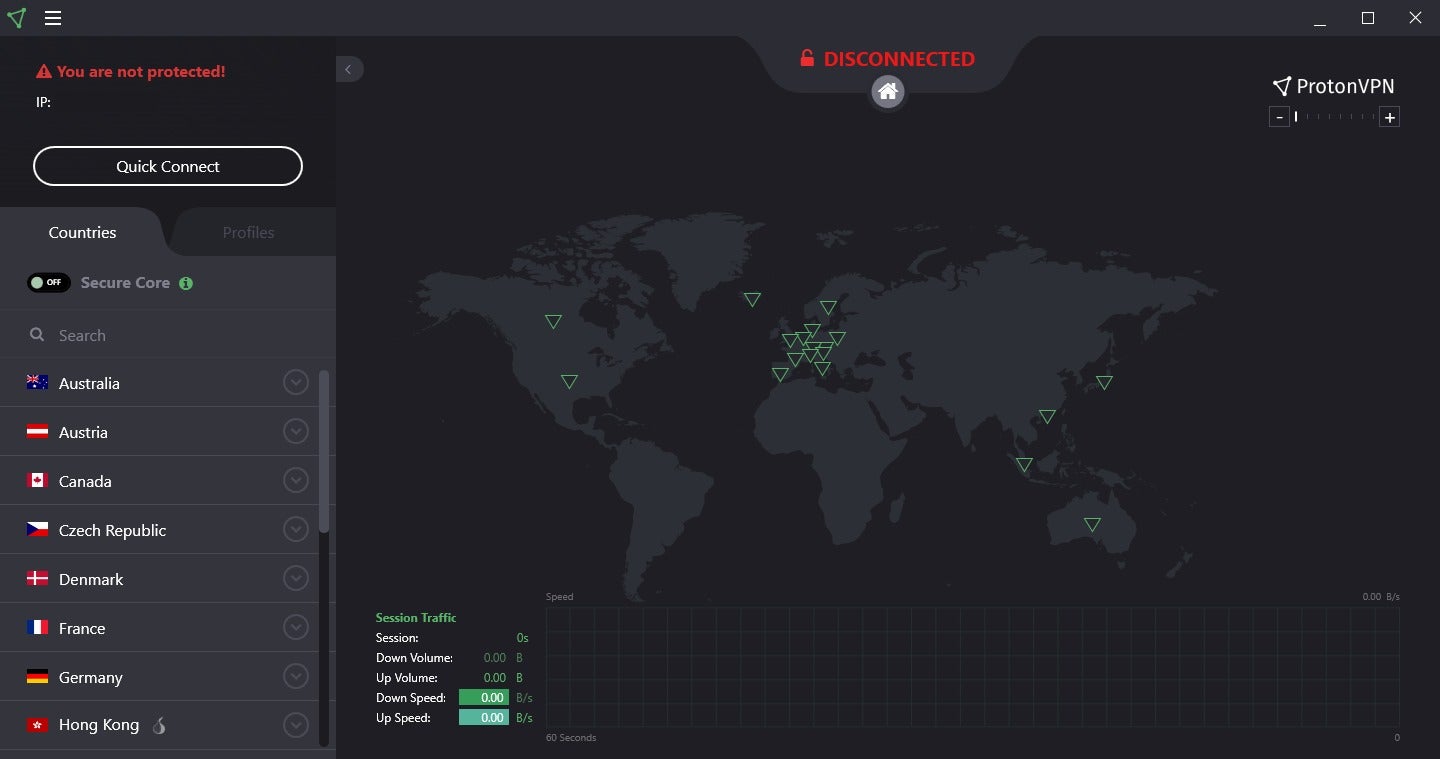
ProtonVPN’s interface.
ProtonVPN for Windows starts by displaying a map of the world with green triangles signifying the countries where ProtonVPN has servers. If you prefer to use the VPN without the map, there’s an arrow button on the top left to collapse it for a more smartphone-like interface.
On the left rail are your connection options. There’s a Quick Connect button at the top if you want ProtonVPN to choose the fastest server based on your current location. Otherwise, you can scroll down the list of countries.
protonvpnserverchoices
IDG
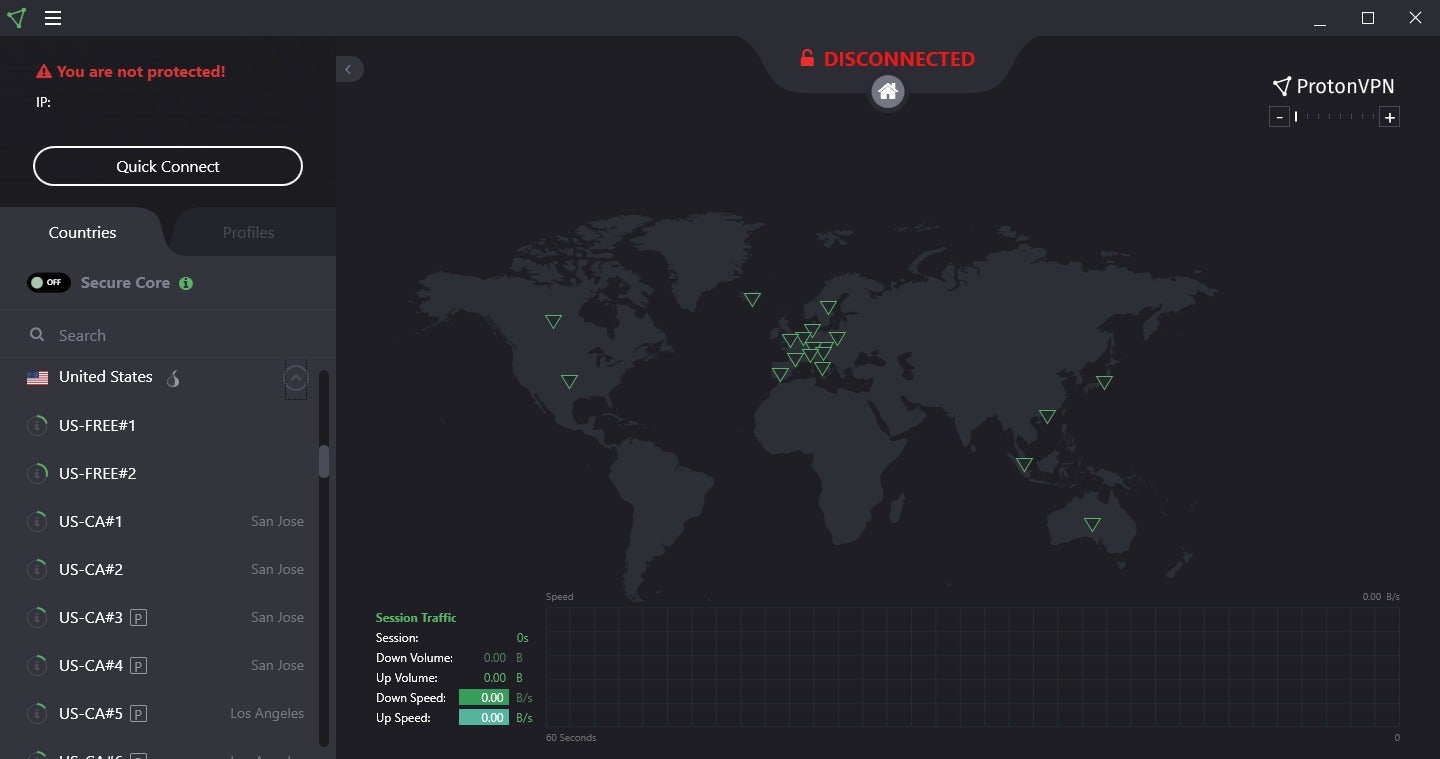
ProtonVPN’s U.S. server choices.
For a deep dive into the country-specific servers, click on the downward facing arrow to the right of each country in the list. This will show you all the server options for that location. There’s a circle with a green indicator for each server showing its current capacity. You can also hover over the circle to find out the capacity measured as a percentage. If you see a “P” in a square next to a server that means its available only to premium subscribers; there are also TOR servers, and the symbol with two arrows indicates the server supports P2P file sharing.
Once you’ve connected, the map transforms showing a line to your virtual location and the home symbol at the top center of the map. Below the map you’ll see connection information such as session duration, up and down bandwidth volumes and speeds, as well as a bandwidth graph.

Features and services

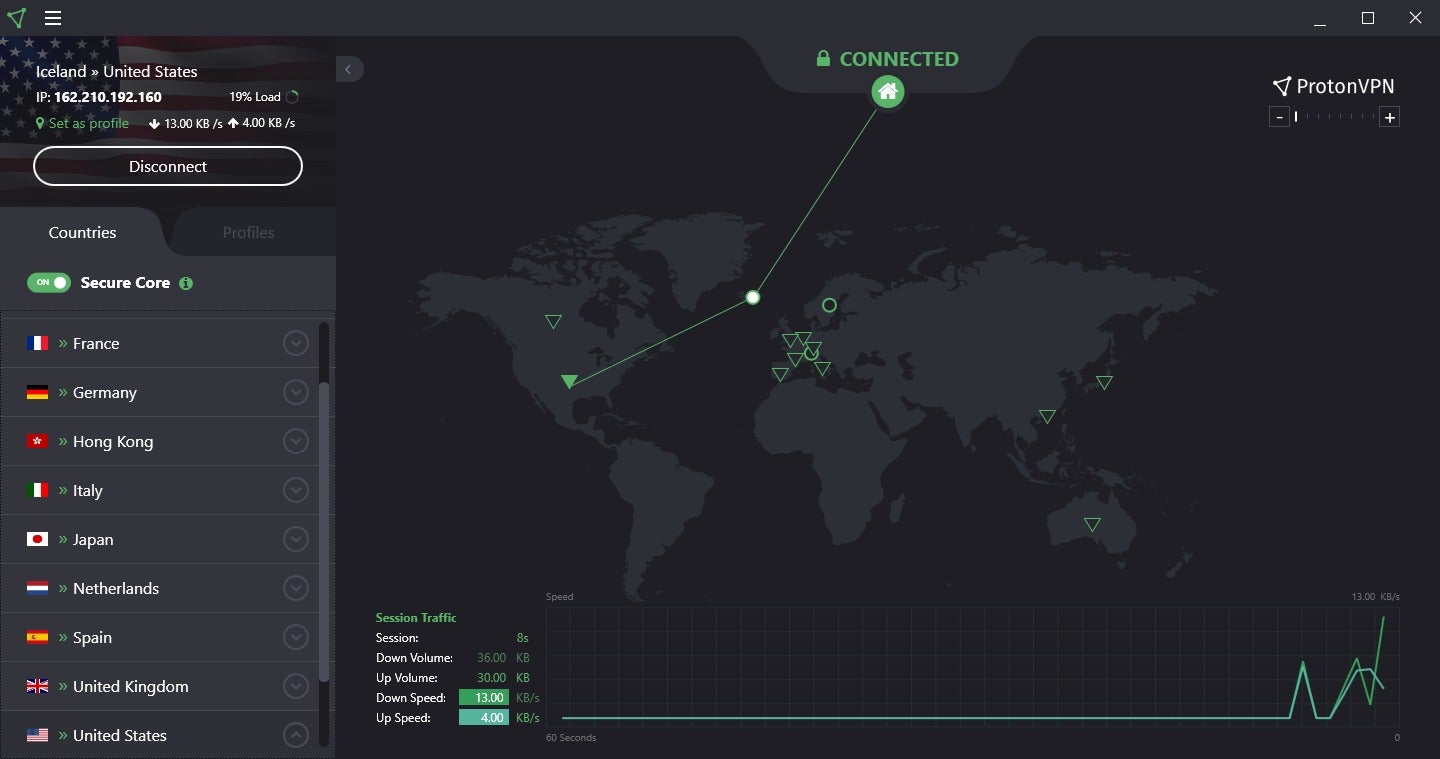
ProtonVPN offers a number of extras depending on which level of service you have. The Secure Core feature is for Plus and Visionary subscribers only, for example. Secure Core is a multi-hop VPN connection where it uses two VPN connections before exposing you to the open internet. But unlike typical multi-hop implementations, Secure Core is a one-click affair where you choose the exit country and have minimal options for the first connection.
protonvpnsecurecore
IDG
ProtonVPN’s Secure Core connections.
The first hop runs through either Iceland, Sweden, or Switzerland before shuttling you off to the country of your choice–only 11 country locations support Secure Core exits. Depending on the country, you may have some choice as to where the first hop goes through, but many countries have only one of the three options. France only supports a first hop through Sweden, for example, while for Germany it’s Iceland.
ProtonVPN says Secure Core puts your traffic through “privacy friendly countries” first (Iceland, Sweden, and Switzerland). The aim is to protect a user’s privacy as much as possible and defend against network traffic monitoring. ProtonVPN says that this method makes it harder for an attacker to discover a user’s true IP address or attempt to match browsing activity to the user. There’s a fuller explanation on the ProtonVPN website. Secure Core must be explicitly activated at the top of the country list in the left rail.
ProtonVPN also supports Forward Secrecy, which uses one-time session encryption keys to prevent someone from stealing encryption keys from a following VPN session and using those to decrypt earlier sessions.
If TOR is your thing, ProtonVPN supports TOR connections over VPN on specific servers. Again, this feature is only available to Plus and Visionary subscribers.
There are also the usual VPN features such as DNS leak protection and an Internet Kill Switch that halts your internet access should the VPN connection drop.
protonvpnprofiles
IDG
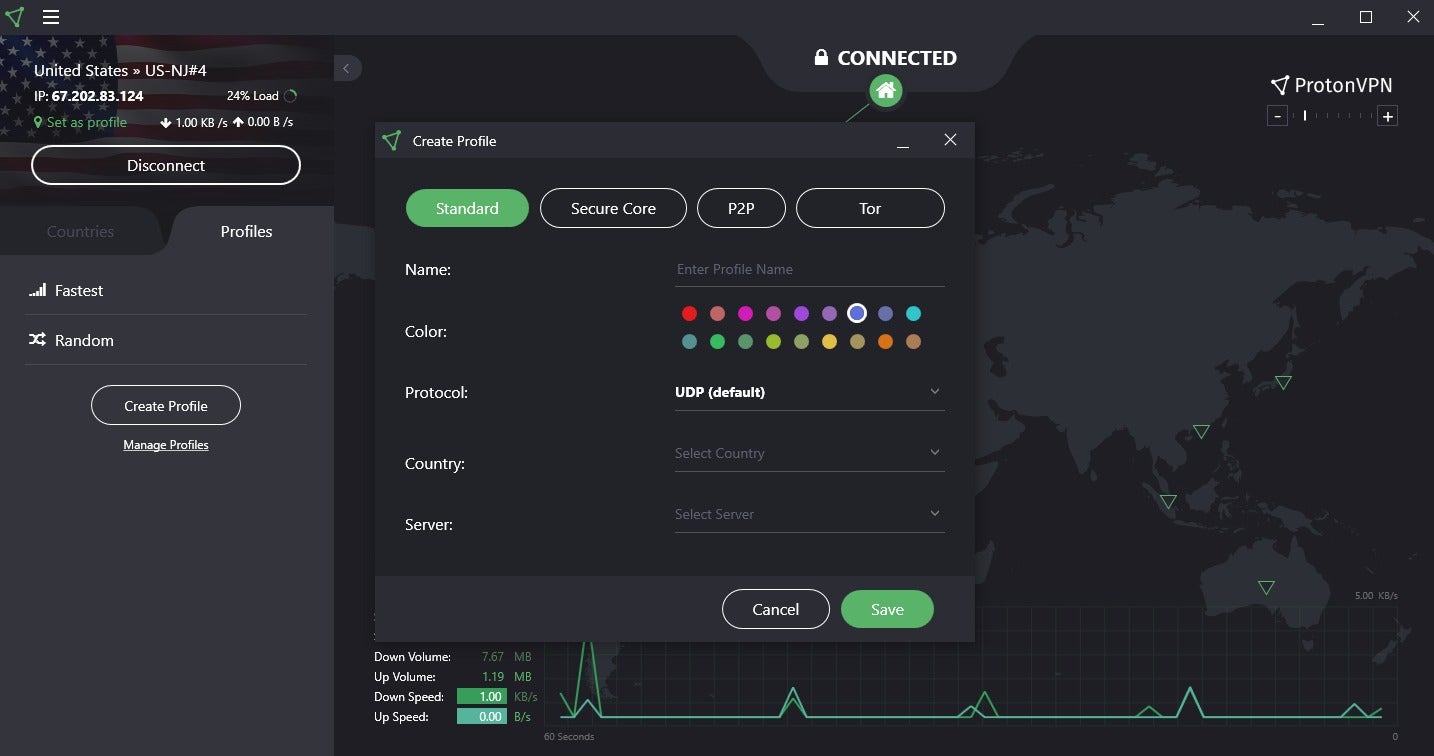
Creating a new profile in ProtonVPN.
If you want to use different VPN connections based on contexts such as home, work, or travel, ProtonVPN lets you set profiles using the tab in the left rail.
When creating a profile you can choose to use a standard server connection, the Secure Core feature, P2P servers, or TOR servers. You can also choose to use OpenVPN over UDP or TCP, and the specific server you want to use.
Beyond VPN configuration, ProtonVPN also touts the security of the data centers it uses in Iceland, Sweden, and Switzerland—the privacy-respecting countries. These are a collection of data centers in former military bases, remodeled fallout shelters, and other hard-to-reach locations. The implication being these servers are physically, as well as digitally, secure.
ProtonVPN is available for Windows, Mac, Android, and iOS. Pricing is varied. The Basic plan gets you “high” speeds and supports two simultaneous devices for $48 per year. The Plus plan is $96 per year, lets you use the VPN on up to five devices simultaneously, offers the service’s top speeds, a larger number of servers, TOR, and the Secure Core feature.
The deluxe Visionary package costs a whopping $288 per year with all the Plus features, as well as a ProtonMail Visionary account.

Privacy, anonymity, and trust

ProtonVPN is managed by ProtonVPN AG, which is run by the same team that runs ProtonMail—Proton Technologies AG. The company offices are at Chemin Du Pré Fleuri 3 Plan-les-Ouates, Geneva, Switzerland. The CEO is Andy Yen, and the CTO is Bart Butler.
protonvpntor
IDG
The ProtonVPN interface with the map hidden.
ProtonVPN’s privacy policy says the company doesn’t track your browsing activity, your IP address, or bandwidth usage. The only thing ProtonVPN says it does track from specific accounts is the timestamp of your most recent successful login attempt. This is overwritten with every successful login. ProtonVPN says it keeps this information to protect user accounts from password brute force attacks. The timestamp does not include your IP address or location, only the time and date of your login, according to ProtonVPN.
If you use ProtonVPN on mobile, the company also tracks crash reports. ProtonVPN also tracks the geographic distribution of its users on an aggregated, global level. It uses this data to help allocate resources, counteract national attempts to block ProtonVPN, and for marketing purposes (ProtonVPN calls this “outreach and growth initiatives”).
For payments, ProtonVPN accepts credit cards, PayPal, cash via regular mail, or Bitcoin via direct wallet-to-wallet transfers. To sign up for an account, ProtonVPN requires a username, email, and password. 
Overall, ProtonVPN provides good privacy protections—although it doesn’t quite rise to the standard of Mullvad, our favorite overall VPN.

Performance

ProtonVPN boasts a minimum 1Gbps link for all its servers with many actually supporting up to 10Gbps. That investment in high-quality speeds appears to have paid off. ProtonVPN comes awfully close but doesn’t quite beat our current speed champion, HotSpot Shield.
For this speed test we ran it two different ways. First we did a test with ProtonVPN in the standard configuration, and then we tested again with Secure Core enabled.
During the standard tests, ProtonVPN was able to keep 61.88 percent of the base speed based on an average from five different countries. All speed tests were standout with almost all of them hitting 50Mbps—only Australia was below that at around 27Mbps. The base speed on the day of testing was around 90Mbps.
Taking a look at Secure Core speeds, ProtonVPN still beat most VPN services we’ve tested. Overall, ProtonVPN scored an average of 46.73 percent of the base speed using the same five locations with a hop from Sweden, Switzerland, or Iceland before that.
Bottom line is that ProtonVPN should offer fantastic speeds for most people, with the obvious caveat that speed results can change based on the capability of your devices as well as your location, home internet connection, and overall user traffic in your area.

Conclusion

ProtonVPN is a fantastic choice for a VPN. Its privacy protections are excellent, though some hard-liners may balk at the single-session time stamp collection. For most users, however, the degree of privacy should be enough. It doesn’t quite rise to the privacy and pseudo-anonymity promises that Mullvad offers, but it’s still really good.
In my tests, ProtonVPN wasn’t a help to get past Netflix’s regional restrictions, but if you’re more interested in security and privacy it’s hard to go wrong with ProtonVPN.
The significant downside with ProtonVPN is that it is far more expensive than other top VPNs. The more common pricing is a year of service with unlimited bandwidth for up to five devices for $40 to $70. The $96 Plus plan is the closest to the standard offering.
Still, you do get a lot of value for your money.
Editor’s note: Because online services are often iterative, gaining new features and performance improvements over time, this review is subject to change in order to accurately reflect the current state of the service. Any changes to text or our final review verdict will be noted at the top of this article.
(source: pcword.com)

SEC looking into Tesla after Elon Musk's tweets, reports say


Yesterday, Tesla CEO Elon Musk tweeted about potentially taking his company private again to expand long-term planning and, probably, to "own the shorts." But he might have moved a little too fast for the tastes of federal regulators.
The US Securities and Exchange Commission has made inquiries into Tesla in the wake of Musk's tweets, The Wall Street Journal reports. According to the WSJ report, as well as others slowly trickling out of Twitter's financial corner, the SEC is looking into whether or not Musk was telling the truth when he said he'd already secured financing to take the company public. If he was lying or embellishing, that could get him in big trouble with the feds.
The SEC is also reportedly looking into whether Elon's use of Twitter constituted sufficient disclosure. Previous SEC rulings on using social media as a platform to make public announcements of this kind say it's fair game, "so long as investors have been alerted about which social media will be used to disseminate such information." It's known informally as the "Reed Hastings rule," after the Netflix CEO who made a post on his personal Facebook page about Netflix subscriptions, which subsequently sent its share price into the upper atmosphere.
The SEC declined to comment on the reports. Tesla did not immediately return a request for comment.
Musk laid out his reasoning for going private in an email to Tesla employees yesterday, which was subsequently posted on Tesla's website. In short, Musk believes going private can place the focus back on long-term planning, which is currently viewed through the lens of how it will affect short-term quarterly finances. He believes the company will be in a better position to succeed if it's privately held.
(source: cnet.com)

18 Science-Backed Tips For Deeper, Longer Sleep

sleep-tips-for-parents


Why, they were all discovered/inspired by dreams of course! Sleep may not solve everything, but it sure solves a lot. Unfortunately for most of us, getting enough sleep can be, er, challenging to say the least.
Maybe, like me, you went into the whole parenting gig thinking that the phrase “sleep like a baby” indicated actual sleep was going to be had by all. You might even have taken some optimistic sleep/snuggle photos when your sweet babe arrived . . .
sleep-tips-for-parents-2
. . . followed by some, um, more realistic ones . . .
how-to-fall-asleep-quickly
Studies show that sleep makes us smarter, more creative, stronger, happier, more productive, and it even keeps us looking younger, so how do we get it when circumstances are not ideal? (source 1, source 2, source 3, source 4, source 5, source 6, source 7)
As a mama of three, I’ve done quite a bit of research on getting deep, restorative sleep, and things have gotten better as I’ve implemented what I’ve learned. Here’s what I’ve found most helpful:

1. Get Sunlight First Thing In The Morning

Our circadian rhythms – which orchestrate the ebb and flow of cortisol and melatonin – are tied to light and darkness. (source) Cortisol helps us get going in the morning, and melatonin tells our body when it’s time to wind down for bed. Problem is, most of us are out of sync.
To get back on track, we need to spend 15-30 minutes in bright sunlight early in the morning. In one study, workers who got regular sunlight tended to be more physically active during the day and got more sleep at night. They were also found to be generally happier and reported fewer health problems, which is a nice bonus.
Although the workers in that particular study got light throughout the entire day, other research indicates that early morning light produces the best effects. (source 1, source 2)
sleep-tips-3

SLEEP HACK #1: INDOOR BRIGHT LIGHT

So let me guess, you don’t roll out of bed, yawn daintily like Julie Andrews, and then go out in your front yard to sing about how the hills are alive with the sound of music. That’s okay, you can still get the benefits of early morning light.
Going outside for 15-30 minutes of sun isn’t practical for my family most mornings, so I bought this daylight lamp and put it on the kitchen table. My kids sit under it and work on art projects while I start breakfast. My plan was to join them and sit for 30 minutes or so planning my day, but I felt frustratingly tethered to my chair and stopped doing it.
Instead, I invested in these space-age looking blue/green light glasses, which allow me to move around the house while receiving light therapy. They’re AMAZING – within three days of using them my brain felt lit up like a Christmas tree. I was able to think clearly and feel focused for long stretches of time instead of short bursts – which is what’s been typical for me since becoming a parent. (That’s not just me, right?)
They’re CNN’s #1 gift pick for travelers, have been featured in Forbes, and were developed by a university – I’ll be posting a full review of them soon, but for now you can find them here.
phillips-wakeup-light
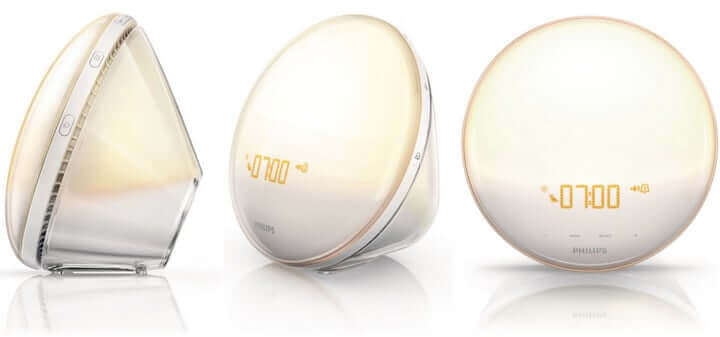
Another option is this wakeup light, which simulates sunrise in your bedroom. It was developed by Phillips, who “carried out extensive research with leading light therapy experts into the relationship between light and well-being. That research showed a positive correlation between dawn simulation and how people feel when they wake up. Waking up to gradual light, like a sunrise, is hard-wired into the human brain. As light falls on a person’s eyes, a message is sent to their brain that stimulates production of cortisol, known as the energy hormone. Waking up to dawn simulation has also been proven to help keep a person’s internal body clock in sync. It helps to regulate our circadian rhythm, promoting better sleep and reduced stress levels – unlike waking up in the dark to a sudden noise like a traditional alarm clock.” (source)
My experience with early morning light: When I lived in the city I slept with blackout curtains so that light from my neighborhood didn’t interfere with my sleep. It helped, but it also meant that my body never experienced a natural sunrise. Now that I sleep out in the country with no light pollution, I experience a natural sunrise every morning. I don’t wake at sunrise (thank goodness), but the gradual addition of light to my room has had some interesting physiological effects. For one – and this is probably TMI – my cycles aligned with the moon. Crazy, right?
blue-light-blocking-glasses

2. Avoid Blue Light At Night

We need sunlight during the day to keep our circadian rhythm on the right track, but sunlight at night? Now, that’s just downright confusing  to our bodies.
Unfortunately, computer screens, t.v.’s, phones and even regular light bulbs emit blue light, which the body perceives like sunlight. According to some studies, blue light exposure after sundown can suppress the release of melatonin, which tells our body it’s almost time for bed. But that’s not all it does – melatonin is vital for health, and low levels can cause more problems than just a rough night’s sleep. According to Chris Kresser L.Ac , low melatonin levels have been:
“shown to increase the risk of cancer, impair immune system function, and possibly lead to cardiometabolic consequences such as type 2 diabetes, metabolic syndrome, obesity, and heart disease. (11, 12, 13) With serious consequences like these, preventing melatonin suppression should be a top priority in anyone’s healthy lifestyle.”
But what’s that – you’re not ready to give up screen time after the kids go to bed? Yeah, me neither, and for that matter I’m not going to turn off all the lights and sit in darkness either. Fortunately, there are ways to reduce blue light exposure anyway, and research has shown them to be very effective. (source 1, source 2)

SLEEP HACK #2: BLOCK THE BLUE

Here are three tips for reducing blue light at night:
  • Bright light suppresses more melatonin than low level light, so dim the lights in your house around sunset. I also dim my computer screen, but that’s optional.
  • To block blue light coming from ambient lights  and my t.v. screen, consider wearing amber-hued glasses at night. Uvex sells a very inexpensive version, but they scratch easily and can make the screen seem a little fuzzy while watching movies or shows. After using them for a long time I finally found these – screens appear crisp and clear with them on, they’re affordable, and they’re more comfortable, too!
  • Install F.lux – It’s a free software that removes blue hues from your computer screen at night. Download it here.
magnesium-and-sleep

3. Optimize Your Levels Of This “Miracle Mineral”

Magnesium fuels about 300 biochemical reactions in the body. In addition, it helps to relax achy muscles, mitigate the effects of stress, and calm the mind by supporting the production of the neurotransmitter GABA.
Sleep problems are often a symptom of magnesium deficiency. We’re not exactly sure why, but we do know that this “miracle mineral” relaxes achy muscles, and calms the mind by assisting with the production of the neurotransmitter GABA and mitigates the effects of stress, so that may be part of it.
This study also suggests that magnesium may improve sleep quality by increasing melatonin levels and decreasing cortisol levels.

HOW TO IMPROVE YOUR MAGNESIUM LEVELS

The best way to get magnesium is through food, because whole foods come with cofactors that help with nutrient absorption. Unfortunately, due to soil depletion and factors such as stress which increase our need for magnesium, it’s difficult to get all we need from food.
Here’s a guide to magnesium supplementation and here’s a bath salts recipe that can help improve levels.
non-toxic-mattress

4. Sleep On A Good Mattress

Duh, right? But seriously, this makes a huge difference. When we sleep on an uncomfortable bed it creates pressure on our hips, back, and shoulders, and we have to move frequently to redistribute our weight. If we don’t, areas under pressure lose circulation and tissue gets damaged. According to the Mayo Clinic, ”Bedsores — also called pressure sores or pressure ulcers — are injuries to skin and underlying tissue resulting from prolonged pressure on the skin.”
Obviously, our bodies do whatever it takes to prevent this damage from happening. Since we don’t typically move around while remaining in Stage 3 and 4 sleep, we have to come up out of that deep, restorative sleep back into lighter sleep to shift our weight.  These “micro-arousals” may inhibit or stop the release of human growth hormone during deep sleep. (source)
In other words, frequently shifting our weight during sleep may prevent us from getting adequate amounts of deep, restorative sleep.
My favorite non-toxic mattress company has solved this problem by creating a mattress that is both soft (for pressure relief) and firm (for proper spinal alignment). I know, it’s always been an either/or choice, but their solution is the real deal.
They have a 60 day, risk-free trial, so if you’re interested in trying them you can have a bed delivered to your door, worry-free. If you decide it’s not for you they will pay to have it shipped back to them. (You do have to pay for shipping to your house and use a mattress protector during the trial period if you think you might want to return it, but if you love yours half as much as I love mine you won’t even consider it.)

5. Give Aromatherapy A Try

In this small study, lavender essential oil  placed in a diffuser improved quality of sleep for individuals who suffer from mild insomnia, and this study concluded that lavender essential oil improved quality of sleep in ischemic heart disease patients. Here’s how I use it in my routine:

AROMATHERAPY FOR BETTER SLEEP

My personal preference is to place a relaxing blend (like lavender, mandarin, ylang ylang, valerian and neroli) into a diffuser right before bed. I have one that I carry from room-to-room with me throughout the day, but eventually I’m going to get this one for my bedroom. It’s beautiful, don’t you think?
A good rule of thumb is diffuse for 30-60 minutes, then take an hour off, then repeat if desired. Many diffusers have a timer that you can set to shut off automatically.
Cortisol_Profiles1

6. Get Grounded

A practice called “earthing” is thought to help regulate our hormonal ebbs and flows with a mechanism similar to early morning light.  In a study conducted by Ghalv, M.D. and Dale Teplitz, M.A, earthing reduced overall levels of cortisol and fine-tuned the secretion cycle so that levels were highest in the early morning, which is when it’s most needed.
To practice earthing, all you need to do is go outside. Read more about it here.

7. Set A Caffeine Curfew (And Stick To It)

Caffeine has a life of it’s own – a half-life, that is. Sip that cuppa joe (with 200mg of caffeine) at 3pm, and chances are pretty good that 100mg will still be active in your system at 9pm. Everyone metabolizes caffeine at a different rate, so do some experimenting and find out when your cutoff point should be. (source)
sleeping-tips-for-deeper-longer-more-restful-sleep

8. Avoid Light Pollution

So, the irony of the above photo is in order to avoid the problems associated with too much light at night, we need to do more than cover our eyes. We now know that our skin senses light in ways we used to think only the eye could, so light can disrupt our circadian rhythm even when we’re wearing a mask.
Blackout curtains are a much better option, and they don’t just come in black. Check out some of the colors that are available here.
Also make sure to cover any lights on your alarm clock or other electronic devices. I throw a clean cloth diaper over our white noise machine/alarm clock every night before bed.

9. Chill Out

“’When you go to sleep, your set point for body temperature — the temperature your brain is trying to achieve — goes down,’ says H. Craig Heller, PhD, professor of biology at Stanford University, who wrote a chapter on temperature and sleep for a medical textbook. ‘Think of it as the internal thermostat.’ If it’s too cold . . . or too hot, the body struggles to achieve this set point.” (source: WebMD)
Experts say the ideal sleep environment for most people is between 65-72F, so find what works for you. I recommend wearing loose, light pajamas to bed so you don’t overheat.
However, if you find that you’re having trouble sleeping because your feet are cold, put on a pair of warm socks. According to this article, research shows that as you get sleepy, your “body’s temperature regulation system redistributes heat from your core to your extremities. Having cold feet demands more from this system and upsets the natural release of melatonin, a hormone related to a proper sleep-wake cycle.”

10. Let The List Go (Just For A Little While)

Do you feel overwhelmed by “to do” lists or other distractions at night? A handful of studies show that meditation and/or relaxation can help you let go and relax. I’ve found belly breathing throughout the day to be helpful, and I also love to listen to relaxing music and/or podcasts while winding down at night.

11. Flex Your Muscles

Though it can take up to four months, exercising for 30 minutes three or four times a week may lengthen the amount of time we sleep while and improve overall sleep quality. (source)
Though I confess I don’t always work it in, my two favorite types of exercise are rebounding and kettlebells. I use this rebounder, which doubles as a playground for my kids when it’s too cold to play outside. (It also folds in half, which I like because I can store it under my bed.) I also have this kettlebell and this kettlebell DVD, which is good for beginners like me.

12. Sip Don’t Slurp

Though alcohol can sometimes help with falling asleep, it actually hurts overall sleep quality by disrupting normal sleep patterns. (source) Researchers are not exactly sure why that is, but some theorize that it has to do with the inhibition of melatonin secretion and/or it’s ability to cause spikes in blood sugar that jolt us wide awake at 2am.
Whatever the reason, if I opt for a big girl beverage (like this this hot buttered rum or spiked eggnog), I make sure to enjoy it early in the evening so that it doesn’t interfere with my sleep. And of course, I sip rather than slurp. 🙂

13. Brew Sleepy Tea

Brew up a relaxing herbal tea like chamomile or kava kava, which studies suggest may help with falling asleep. (source 1, source 2) I like to add in a few additional things to my tea to make it more potent:
  • 1-2 tablespoons of grass-fed gelatin. It’s rich in glycine, which is very calming, and also contains other amino acids that are thought to help with sleep. (source)
  • Honey to taste, which may help with glycogen synthesis
  • A pinch of salt, which some experts believe helps reduce excess cortisol in the body

14. Take A Hot Bath

While our bodies are designed to sleep best in a relatively cool environment (usually 65-72F), this study found that a hot bath 1.5 hours before bed decreased sleep fragmentation in older adults suffering from insomnia.

15. Try Pink Noise

Want to do a little experiment? Listen to this for just sixty seconds, and then read on. (Seriously, try it. It’ll be fun.)
Are you thinking, “Whoa, what was that?” Good! It’s called pink noise, and it’s essentially white noise that has been filtered to be less harsh.
Researchers think it helps sleep because the “steady drone of pink noise slows and regulates your brain waves, which is a hallmark of super-restful sleep.” (source)
In this German study, “pink noise appeared to prolong deep sleep and to increase the size of the subject’s brain waves during that period, as evinced by their EEGs.” According to the writeup, “The slow brain waves that characterize deep sleep are implicated in information processing and memory formation, and sure enough, on the mornings after those brain waves appeared to have been enhanced, the participants remembered a higher number of word pairs (an average of 22, as opposed to 13).”
In another study conducted by Jue Zhang, Ph.D., an associate professor at China’s Peking University, “An impressive 75% of study participants reported more restful sleep when exposed to pink noise. When it came to brain activity, the amount of “stable sleep”—the most restful kind—increased 23% among the nighttime sleepers exposed to pink noise, and more than 45% among nappers.”  (source)

HOW TO INCORPORATE PINK NOISE FOR DEEP SLEEP

“To experience the benefits of pink noise in your own bedroom, Zhang recommends fans or noisemakers that produce steady, uninterrupted sound or that imitate falling rain or wind,” writes Prevention Magazine.

16. Respect The 10-2 Window

I recently heard Dr. Alan Christianson – author of the upcoming book The Adrenal Reset Diet– say at a small gathering that our bodies are hardwired to do most of their intensive healing/repair work between the hours of 10pm-2am. This may be because in more primitive environments, this window of time is the safest for us to be out of commission.
Remember, we don’t move in the deeper stages of sleep, so we’re more vulnerable. It’s probably best to get that kind of sleep out of the way while predators are still groggy from waking up for their “day,” so that when predators are fully awake and prowling we can run away if needed.
Another interesting phenomenon Dr. Christianson mentioned was the second wind. Have you ever been soooo done with a day that you were ready to go to bed at 6pm, only to find yourself wide awake and scanning Facebook at 10:30 pm later on? Chances are, your body released hormones intended for intensive repair (aka beauty sleep), but because you hadn’t gone to bed yet you experienced it as an energy rush instead.
Now that I know what the second wind is, I try to avoid it, and I’ve noticed it makes a big difference as I work to heal my tired adrenals. I want all those lovely hormones to repair my body and help me feel good, not keep me up watching cat videos on Facebook.

17. Turn Off Wifi At Night

In his new book, Overpowered, Dr. Martin Blank of Columbia University argues that EMF exposure is having a profoundly negative effect on our bodies, especially when it come to DNA repair. Dr. Blank doesn’t recommend complete avoidance, but suggests instead that we take precautions with them just like we do with other activities – like wearing seat belts while driving.
Since much of our most important DNA repair activities happen while we sleep, it may be wise to turn off sources of intense EMF exposure during that time.
Note: In addition to turning off wifi, I would also keep cell phones out of the bedroom. However, if it was absolutely necessary to keep it nearby I would put it in airplane mode.

18. Drink Cherry Juice

According to one study, adults suffering from insomnia slept an average of 84 additional minutes after consuming tart cherry juice two times per day for two weeks. Some parents rave about cherry juice as a children’s sleep aid, including my friends Genevieve of Mama Natural and Cara of Health Home & Happiness.
(source: mommypotamus.com)